
Was the Technate Inevitable from the Start?
Lessons from the Covid era ... and before....

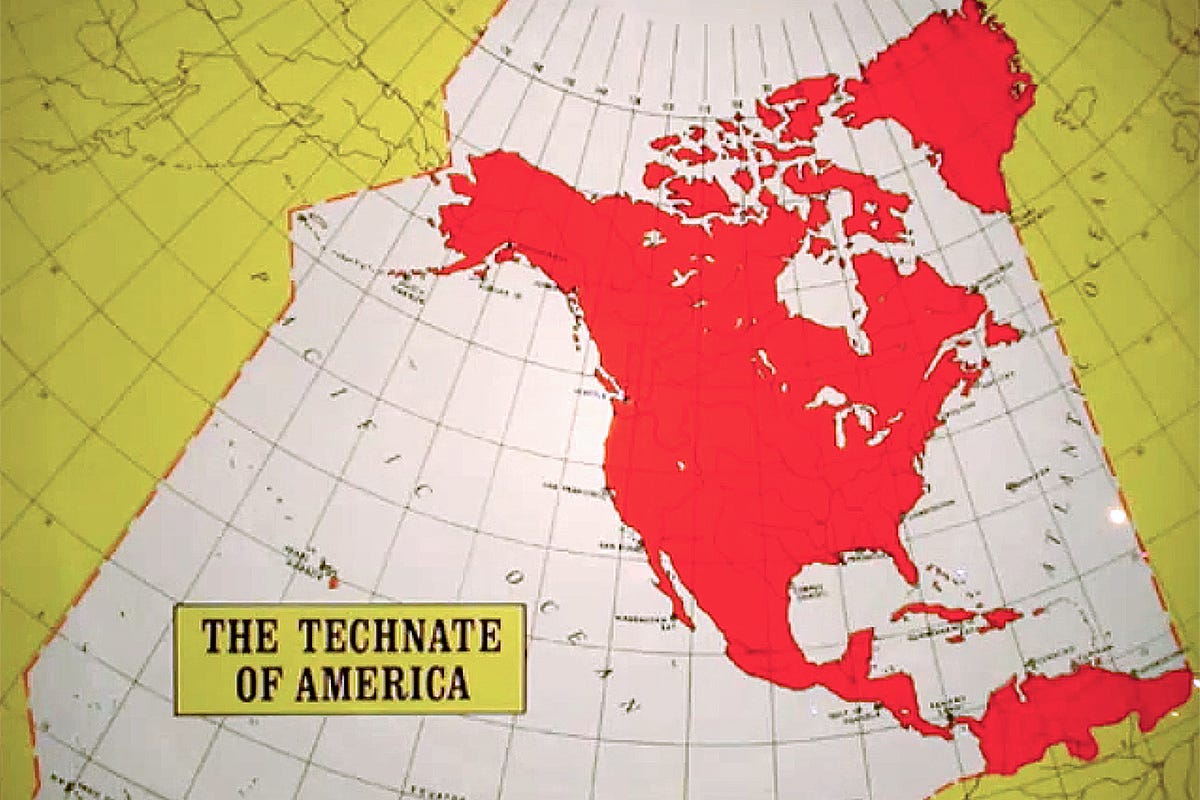
“The Technate Was Always Coming.”
Last week I ran across a thoroughly depressing article. The author owns a small tech company which I presume pays him enough to live on while he runs his own commentary site. I have no idea how much traffic he gets.
His name is Mark E. Jeftovic, and the article’s title is “The Technate Was Always Coming.”
He argues a compelling case that has been in the back of my mind at least since Captain Covid came to call.
It’s that when Technocrats come out of the closet in force following whatever (financial, war-related, or both) debacle is in the works, they will have far less trouble establishing their American Technate than we dissidents want to believe.
Jeftovic’s point of departure was the now-infamous 22-point “manifesto” Alexander Karp, billionaire CEO of deep-state embedded surveillance-and-control leviathan Palantir Technologies, dropped a few weeks back. (Read it here.). The “manifesto” is just a quick summation of the book he cowrote, The Technological Republic: Hard Power, Soft Belief, and the Future of the West (2025).
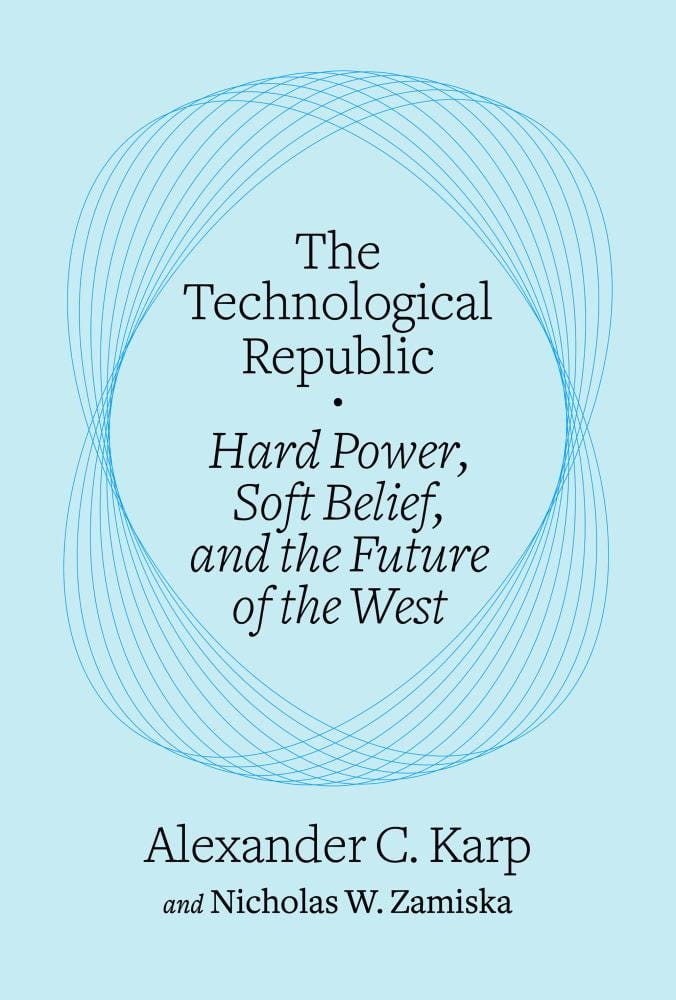
Jeftovic’s bemused query: why were so many people so surprised to see it?
If that seems like a strange question, that’s part of the problem!
You see, Jeftovic goes on to show that such pronouncements have been circulating for well over a decade now. Karp didn’t just pull that manifesto (nor the book) out of his hat.
Patrick Wood, whom I cited last week, has been researching and writing about Technocracy far longer than I have. Among the things cementing his credibility is having worked under, and with, the late, great Antony C. Sutton who labored tirelessly unearthing ties between banking titans and the most brutal dictatorships of the twentieth century. Sutton’s books have names like Wall Street and the Rise of Hitler (1976). They were readily available. Nobody reviewed them, but nobody suppressed them, either.
They just weren’t read and their messages absorbed, except by a tiny minority. This is probably typical. The average person’s unconsciousness of anything that doesn’t affect him or her directly and immediately — until it’s too late — has consistently worked to the advantage of the power-hungry.
Libertarian Fantasies and Technocratic Realities.
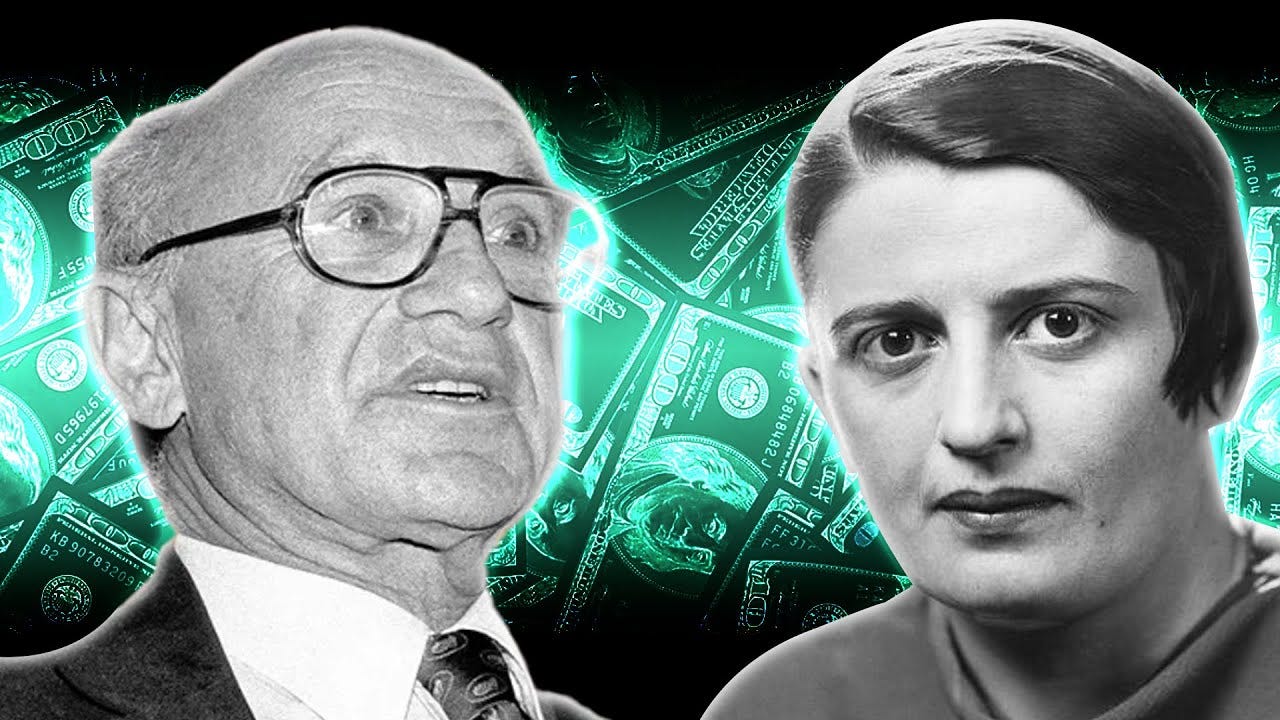
We were, by the 1980s, seeing the meteoric rise of a certain political-economic mindset that could be streamlined as follows: government and policy bad, corporations and markets good. With minor variations. The roots of such thinking came from authors such as Ayn Rand and social thinkers like Friedrich A. Hayek and eventually Milton Friedman, the main founding father of neoliberalism.
Libertarians furthered market fundamentalism as an ideology as neoliberals and neoconservatives rose to influence during the “morning in America” era of the 1980s and 1990s. It wasn’t that they didn’t see the merger of actually existing corporate and state power. They chose to dichotomize, to portray the reality with such terms as crony capitalism in order to maintain market fundamentalism as an ideal, even though a perfectly “free market” never existed and never could exist (it wouldn’t be stable).
How do I know this? Because I was there. I’m as guilty as anyone of perpetuating this mythos back then. (Most of the articles I wrote back then are gone from the web. Too bad. You would have been amused.)
Such movements sent most of us who prefer freedom to servitude down rabbit trails of over-intellectualized unreality, introducing oversimplified dichotomies between, e.g., harsh and atomistic “individualism” versus warm and fuzzy “collectivism,” where many remain to this day — on whichever side.
Meanwhile, Technocracy moved forward: with the Trilateral Commission and other such behind-the-scenes groups, with NAFTA and other manifestations of “free trade” ideology, with the UN’s Sustainable Development agenda, with the World Economic Forum, and finally with the rise of a distinct Silicon Valley culture and the “tech bros” leading to our present Second Gilded Age.
Few seemed to notice what was really going on behind all the ideological hairsplitting and academic-type navel gazing. (Again: myself included, until around 2004 or thereabouts.)
Most would still fail to see it, even when it began showing up on their desktops.
To apply: Jeftovic, in a crucial passage:
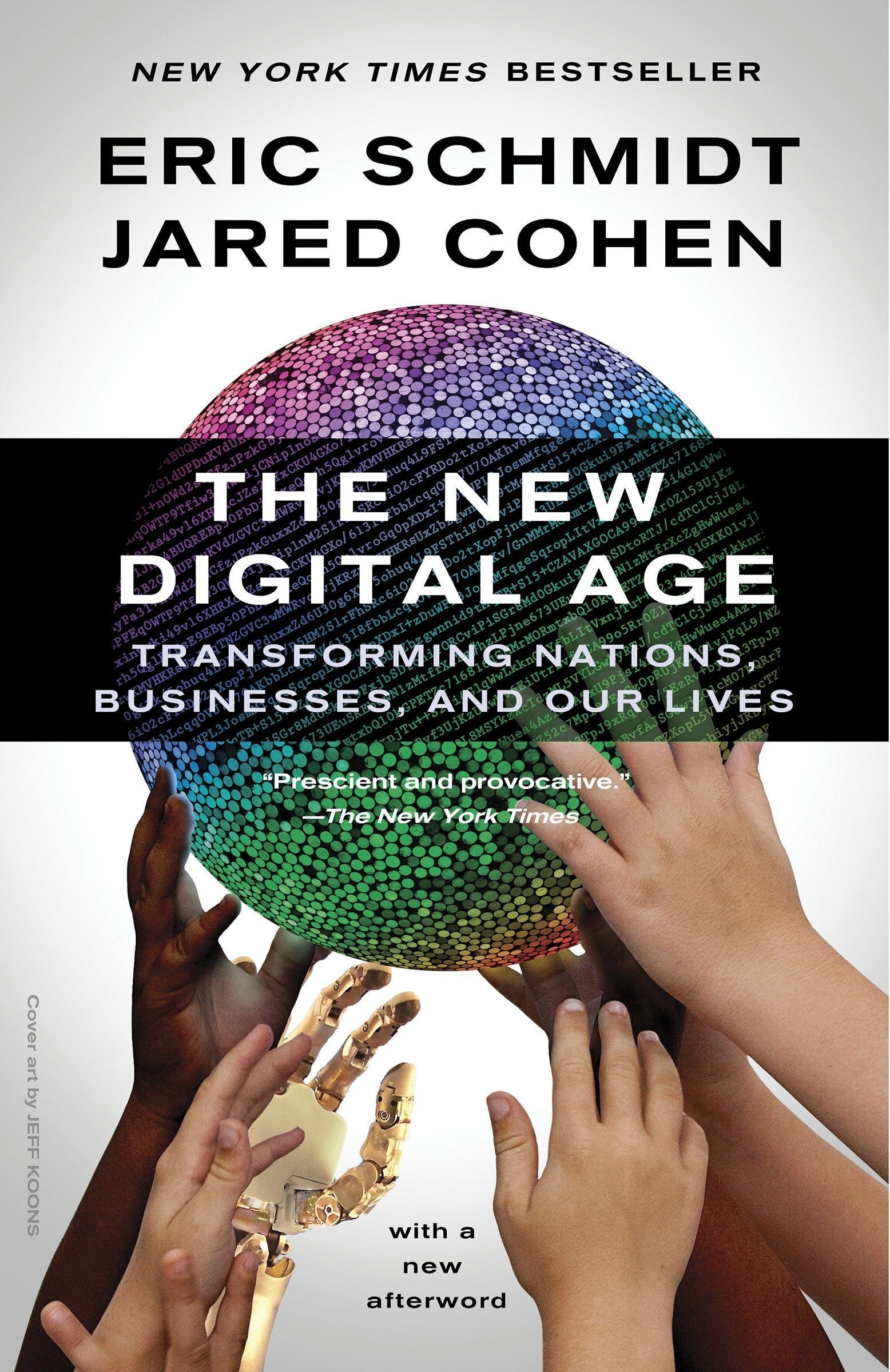
Back in 2013, Eric Schmidt (then Google’s executive chairman) and Jared Cohen (Google Ideas, ex-State Department advisor to Condoleezza Rice and Hillary Clinton) published The New Digital Age. The book was blurbed by Henry Kissinger, Madeleine Albright, Tony Blair, and General Michael Hayden, the former director of the CIA. That’s an elite-class blurb list for a book that explicitly argued for the intersection of Silicon Valley and state power, the fusion of corporate infrastructure with national security logic, and the reshaping of diplomacy through private platforms.
In 2013 it was called “transformational.” Kissinger gushing that it was, “a searching meditation on technology and world order” (he would go on to co-author The Age of AI with Eric Schmidt that should be every bit as concerning as Karp’s Technological Republic).
Not too long after that, Google’s Sergey Brin and Klaus Schwab held a fireside in Davos where Herr Schwab pontificated that with the advent of AI, since the algos would be able to predict election outcomes with 100% certainty, they may as well pick the winners anyway and we could do away with elections altogether.
Nobody batted an eye….
Nope. I don’t recall any rage about such things back then, although we were amidst the transforming of Internet 1.0 (the highly decentralized “information superhighway”) into Internet 2.0 (controlled by Big Tech platforms whose billionaire owners are interested primarily in extraction, profit, and social engineering).
My own audience seemed to drop precipitously during the 2010s. At the time I had no idea why. I certainly wasn’t doing anything differently. Maybe that was the problem. I was still writing as if I was on Internet 1.0, which wasn’t as crowded, noise-filled, attention-driven, and driving a massive overproduction of “content.”
I hadn’t set out to master the art of being an “influencer” or something like that.
But I digress. The point is: Technocratic ideas and strategies have been around for a very long time. So has evidence of the machinations of the wealthy and powerful working systematically to undermine Western traditions and return us peasants to serfdom, whether it used the term Technocracy or some other word or (as was often the case) no self-identifier at all.
Weak and Scattered Opposition.
Where was the opposition back when opposing these forces might have made a difference?
Were we all too busy enjoying the new toys and shiny objects the digital revolution had put in front of us?
Many on those rabbit trails applauded all the “innovation” they saw rather than looking at what was really driving it.
Others contended, with credibility, that we’d departed from the Christian premises on which what was best in Western civilization was erected: habeas corpus and the right of due process, traceable to the Magna Carta of 1215, rooted in the Christian idea of the intrinsic value of the human person and implying that worldly power was accountable to a Creator — and that ultimately “the divine right of kings” was a fabrication of the ruling elites of the day.
The Enlightenment did us a favor exploding such myths. But then it took a dark turn, equating critical thinking with rejection of religion and an embrace of incipient empiricism. The premise that only this world, the world of space and time, existed, because that was the only world empirical science could investigate, led straight to the materialist worldview.
Materialism has been the dominant worldview ever since. (And as long as its most visible [controlled] opposition is “Christian” Zionism, it will stay dominant.)
Part of my argument is that the telos and apotheosis of materialism are Technocracy.
For those who want power, the logical culmination of a worldview in which they answer to no one Higher than each other is that ultimately there are no reasons why they shouldn’t engineer society and rule as they see fit … even exterminating those who don’t fit.
But that’s not the worst.
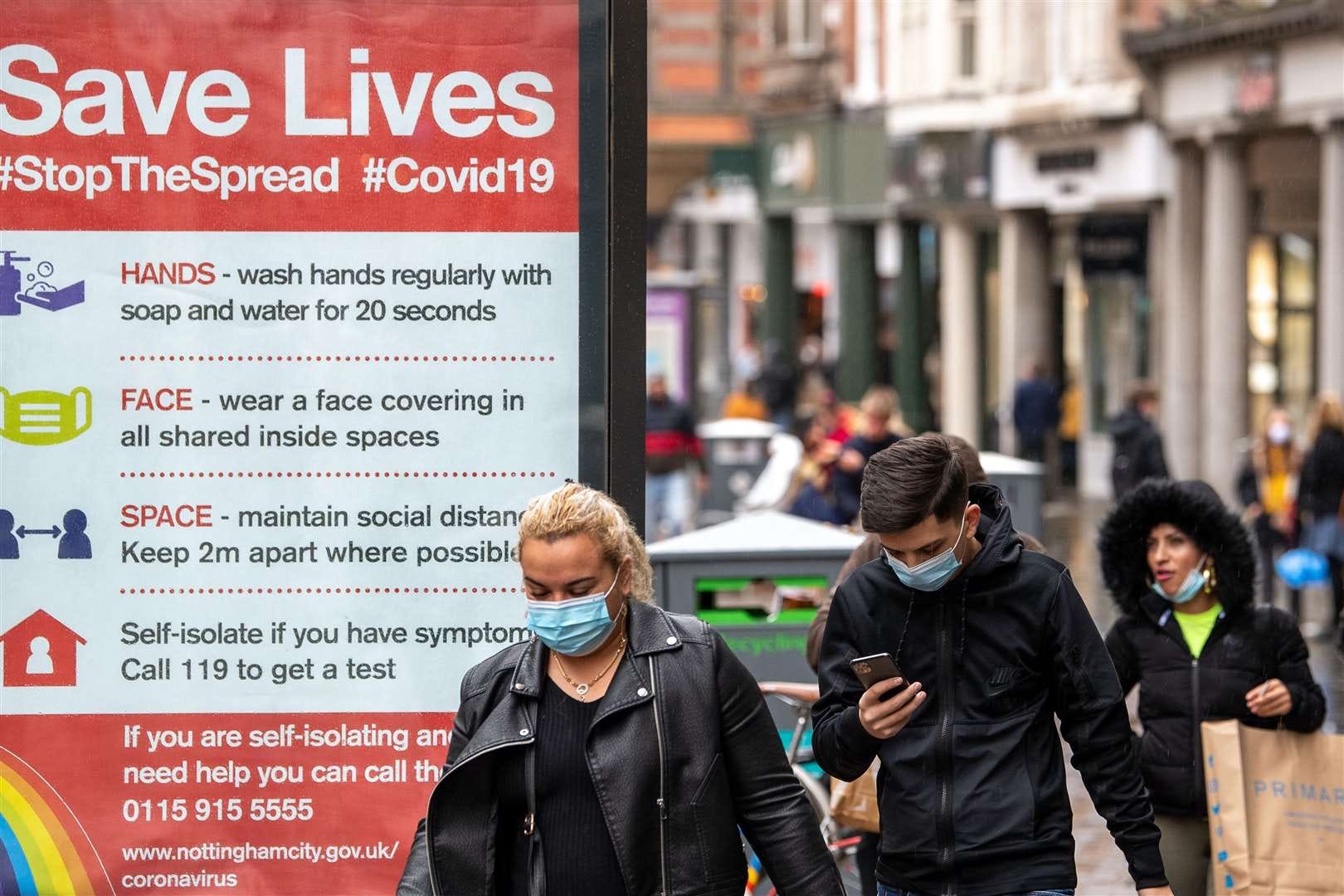
Why the Masses Obey Their Masters: Incentivization Lessons from Captain Covid and Others.
Jeftovic again:
You put your hand up for this.
Perhaps not you personally. But collectively, “we”, the Western mass public already ran a dress rehearsal. And we all passed (or flunked) with flying colours.
During the pandemic and in the years immediately after, the political and managerial class was wrong about effectively everything.
The origin of the virus. The (non)-efficacy of lockdowns. The vaccines didn’t work and were in fact, kill-shots for many. The money printing.
The correct response to being that wrong, that publicly, and that unwaveringly, about that much, should have been pitchforks and torches in the streets, if not guillotines.
At the very least, in our enlightened civilization: recall elections, mass firings, inquests and class actions. There should have been a generational reckoning with expertise that got captured by politics, a media cartel that went full agitprop and Chapter-7 bankruptcy for institutional credibility.
That is not what happened.
What happened instead was that people stood on the dots. We wore the masks on the walk from the restaurant door to the table, then took them off to eat, sitting in saran wrap bubbles on the street in the middle of winter.
People snitched on their neighbours. They watched elites throw lavish maskless parties while they got tased by cops at their kids’ soccer games.
In other words: we “followed the science”, even as the science was revised quarterly to match policy because the facts on the ground refused to conform to the narrative.
And now, most people will fight tooth and nail to defend the very system that did this to them.
The pandemic was the trial balloon. The political class, Wall Street, and Silicon Valley watched carefully.
What they learned was this: the population will comply. The population will inform on itself. The population will absorb humiliating, contradictory, demonstrably false directives from authorities, and the dominant social behaviour will be enforcement of those directives on anyone who objects.
Is he right or is he right?
To expand:
Much of the peasantry isn’t especially difficult to control through a careful combination of scare tactics, incentives, and disincentives. The 24/7 scare tactics used by corporate media compelled desirable mass behaviors during the early days of Captain Covid.
Edward Louis Bernays, who was Sigmund Freud’s nephew, hit on incentive structures such as celebrity advertising to sell products (some of them dangerous, like cigarettes) for corporations. He became a multimillionaire.
Or brand someone a conspiracy theorist, an antivaxxer, an antisemite, or whatever is the demon word of the week. Most of a public conditioned to respond to such words in the desired way will stop listening.
Entire trends have been memory-holed.
Technates Emerging Everywhere.
The idea of Technates has been around since the 1930s, as I’ve noted previously. See the sketch of the proposed American Technate, and think about Trump’s periodic calls to annex Canada as “the 51st state” (also Greenland). Think about Trump’s de facto coup putting himself in charge of Venezuela without changing a single other thing in terms of the top-down governmental structure there, or saying or doing anything to suggest that the lives of ordinary Venezuelans matter.
Technocrats approve of top-down actions, after all. Peasant lives don’t matter unless they’re in some way profitable. They want to replace political governance with control by scientific/engineering “expertise” and management.
None of this is new.

The Chinese have arguably created a Technate that controls 1.4 billion people.
Do you think that if the Technocrat class has learned that one species of its ilk can bring that many people under a single control grid, their Western counterparts can’t do it with far smaller and scattered peoples? (Many of the latter don’t get along with one another, moreover, and the retribalization of identity politics is definitely something they can use: if groups are looking at one another with animosity they aren’t looking at those holding the puppet strings.)
Dubai is, in many respects, a Technate. So is Singapore. City-states in the sense that Theil and Karp have championed as their ideal.
Technocrat plans for rebuilding Gaza are on the drawing board, under the auspices of Trump’s Board of Peace. I’m not holding my breath waiting for them to ask any Palestinians’ approval.
The Technocrat class is working on a massive trade corridor extending from India to the EU, as I noted last week.
Iran alone stands in their way.
Do you think that might have something to do with how that country has been demonized?
No, I’m not defending that government. But I’d like to see Iranians ask the same question Israeli’s ask of their own country: “Does Iran have a right to exist?”
As Tucker Carlson observed (and was demonized for doing so), Israel is the only country about which this question gets asked. No one asks, e.g., “Does the U.K. have a ‘right to exist’?” or “Does the U.S. have a ‘right to exist’?”
Support for Israel in the U.S. is plummeting. Especially among the young. Zionists are in a panic. That’s why we’re hearing so much about “antisemitism” on Tucker Carlson podcasts, on campuses, etc.
Obviously Technocrats have a lot of work to do to bring Americans in line.
Or do they?
Incentive Structures and the Lure of Convenience.
Read what Jeftovic said again.
Huxley got it. Which is why he took the view that the dystopia he wrote of in Brave New World (and warned of further in his slim nonfiction tract Brave New World Revisited) wouldn’t be based on people’s avoidance of pain but rather their love of pleasure.
Incentives.
Desires which, once they’ve been tasted, become insatiable.
Those who want control will supply satisfactions for them for free!
Dopamine hits from the personal validation implied by “likes,” “followers,” “shares,” etc., on social media. Dopamine is our era’s real world soma.
Convenience.
Our parents and grandparents had to drive or walk to stores. Nowadays folks can order food from their bedrooms.
They have apps.
Food delivered to their doors by low-paid gig workers.
Never mind near-monopolization.
The convenience of the digital landscape has wiped out entire bookstore chains.
Walk through a typical American mall; you won’t see a single bookstore, whereas when I was in high school, the nearest mall to where we lived had three.
Only Barnes & Noble has weathered Amazon’s monopolization.
Maybe a few used bookstores with local visibility in college towns have survived.
You will not see many stores that sell vinyl records or CDs. Last year I needed a new CD player. I had a difficult time finding one in a store. That’s because nearly all music is downloadable now.
Never mind that all these websites and apps are collecting the information their users have supplied voluntarily when they set up their “free” accounts and are reselling it to other corporations.
To many, this is progress.
To those of us who have been observing the progress of Technocracy, it’s evidence of how easily the peasantry is lured in, monitored, controlled.

Artificial Intelligence.
AI is likely to make things worse. People aren’t writing anymore, not like they once had to. They’re having AI write for them. They’re having AI do their research for them, because AI can “research” in less than 20 seconds what once took a person an entire day.
And it’s getting better and better. I can find reasonably good films on YouTube made with AI. They are getting closer and closer to indistinguishability from films made with real actors and actresses and in real settings.
Could AI render all these career choices obsolete within five years if not sooner?
I don’t know.
A groundswell of rebellion is building, whether driven by anxiety over jobs or over data centers driving up the cost of utilities.
Then there’s the question of whether AI will deliver the goods for corporations heavily invested in it, goosing the stock market to insane highs while the majority of the public is struggling to make ends meet.
Even corporate leviathans like Goldman Sachs are warning that AI “may be” in a speculative bubble. We’re seeing this in the data center “boom”: steep valuations, overbuilt infrastructure, on top of speculation and artificially engineered “growth.” All these are hallmarks of bubbles that have burst before and left devastation behind. Recall the dot-com bubble of 1999 or the housing bubble that began to deflate with the subprime lending fiasco in 2007 … a year before the real implosion the following year.
Needless to say, no billionaire CEO has paid for his recklessness.
To the Technocrat mind, AI is a path to Godhood! Some see themselves — perhaps with a few peasants as guinea pigs first — merged with technology into “transhumans” with enhanced capabilities.
Possibly even immortality!
I strongly suspect that these visions, rather like those of a Skynet that comes to life and takes over the world, will remain science fiction: the product of those whose unstated premise is that consciousness is just “matter” configured a certain way, generated by a brain, and so could be brought to self-awareness with the right recursive self-improving code.

How AI Will Serve the Technate.
AI wouldn’t have to do that to serve the purposes of Technocrat control. It wouldn’t even have to goose the stock market indefinitely. All it would have to do is serve a repository for totalizing and utilizing our information.
Based on all this, I think we can infer that when digital ID, central bank digital currency, and social credit are introduced as the ordinary joe’s and jane’s way out of financial ruin during the coming collapse when the AI bubble bursts, they will be incentivized.
They will be gamified.
Contests will be set up. Who has gotten the best credit score in District 7? Who has the best carbon footprint? That sort of thing. AI will be able to engineer and manage such projects in seconds. Dystopia will be designed to entertain, because entertainment works. People will watch and enjoy. They will no more notice the iron cage around them than did those who Followed The Science back in 2020-22.
____________________
Steven Yates is a recovering ex-academic with a PhD in Philosophy. (Obtain his recent slim tract on the “wisdom” of obtaining such a degree here.)

(www.amazon.com)
He has worked out a detailed comparison and contrast between Christian and materialist worldviews in his What Should Philosophy Do? A Theory.
(www.wipfandstock.com)
He taught for more than 15 years total at several colleges and universities in the Southeastern U.S. He has authored three books, more than 20 articles, numerous book reviews, and review essays in academic journals and anthologies. Refused tenure and unable to obtain full-time academic employment (and with an increasing number of very fundamental philosophical essays refused publication in journals), he turned to alternative platforms and heretical notions, including about academia itself.
In 2012, he moved to Chile. He married a Chilean national in 2014. Among his discoveries in South America: many of the problems in the U.S. are problems everywhere, because human nature is the same everywhere.
He has a Patreon.com page. Donate here and become a Patron if you benefit from his work and believe it merits being sustained financially.
Steven Yates’s book Four Cardinal Errors: Reasons for the Decline of the American Republic (2011) can be ordered here.
His philosophical work What Should Philosophy Do? A Theory (2021) can be obtained here or here.
His cosmic horror novel The Shadow Over Sarnath (2023) (written for the sheer fun of it) can be gotten here.
Should you purchase any (or all) books from Amazon, please consider leaving a five-star review (if you think they merit such). Readers notice, and so does the almighty algorithm.
Hi Steven, humanity is playing out the tower of Babel story all over again. The sad thing is that it seems to me that the incentive structure of this reality is toward ever-increasing centralization and technocracy; this is because both provide power advantages over others, and if one doesn't pursue that then someone else will - it's a race to the bottom. Rene Guenon commented on this as the "solidification" of the world in terms of ages and cycles, that the world will "solidify" and speed up until it reaches a point that it can no longer do so, and then the grand cycle starts over.
Personally, I see nothing that will stop the "Mark of the Beast" CBDC + AI + social credit score dystopian Hell with programmable money and programmed behavior on an individual basis coming very soon, which will result in the greatest loss of individual freedom in human history.
Good stuff, but I think Iran is 'in the game' as well as the ever present Middle eastern Bogeyman just 3 weeks away from developing a nuclear weapon...for the last forty years. And jabbing everything that moved during the assault upon humanity known as Covid as per The Orange Vax Daddy did in the States. And Carlson? CIA Family and MK Ultra'd surely. Who was it that said all the world's a stage?
Perhaps you are right and the chance to put liberty over convenience has lapsed.